Best Phones for Battery Life 2026: Android vs iPhone Compared q1
- vitowebnet izrada web sajta i aplikacija
- Mar 17
- 9 min read

best-phone-battery-life-2026-android-vs-iphone
Best Phones for Battery Life 2026 — Android vs iPhone Compared
Which phones have the best battery life in 2026? We compare Android and iPhone across every price tier with real-world usage hours, charging speeds, and specific model recommendations. Includes 5G battery impact, charging comparison, and the full truth about mAh vs battery life.
The Battery Life Truth: mAh Is Not the Whole Story
A 6,000mAh Android battery does not automatically last longer than a 4,000mAh iPhone battery. Battery life is determined by the combination of battery capacity, processor efficiency, display power consumption, software optimization, and background activity management. Apple's A18 series and Qualcomm's Snapdragon 8 Gen 4/5 are both built on TSMC's 3nm/2nm processes — delivering efficiency that makes their smaller batteries competitive with larger-capacity processors on older nodes.
What the numbers actually mean: Apple's iPhone 16 Pro Max with 4,685mAh consistently matches or exceeds the real-world battery life of Android flagships with 5,000–5,500mAh batteries because of A18 Pro's exceptional power efficiency. Meanwhile, Motorola's budget phones with 5,000–6,000mAh batteries on older, less efficient chips may deliver comparable hours but charge much more slowly.
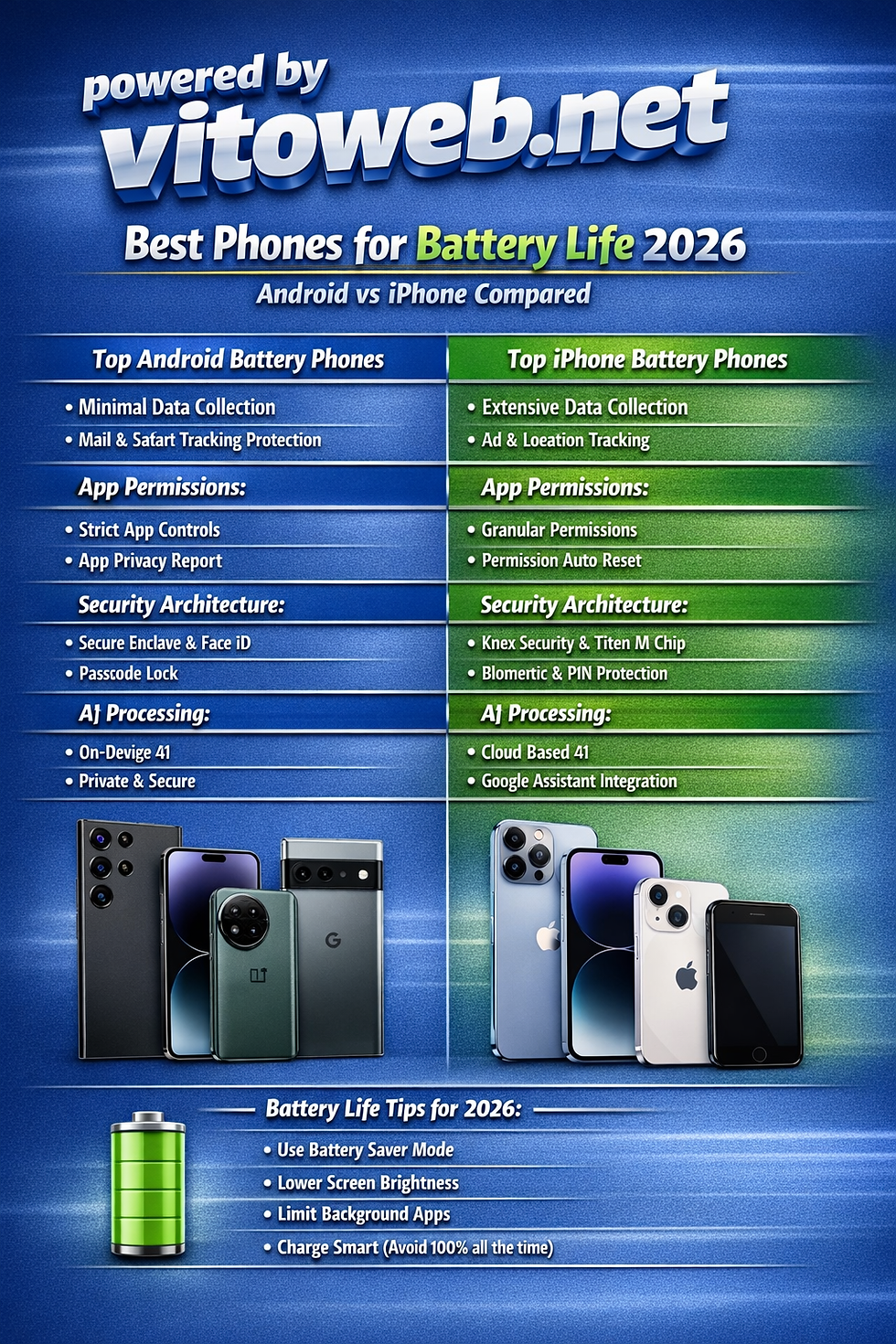
2026 Battery Life Rankings by Category
All-Day Powerhouses (Best Battery Life, Any Price)
Phone | Battery | Est. real-world | Charging | Price |
OnePlus 14 | 5,800mAh | 16–18 hours | 150W (0–100% in 21min) | $799 |
Samsung Galaxy S25 Ultra | 5,000mAh | 14–16 hours | 45W | $1,299 |
iPhone 16 Pro Max | 4,685mAh | 13–15 hours | 30W | $1,199 |
Google Pixel 10 Pro | 5,000mAh | 13–15 hours | 37W | $999 |
Motorola Moto G Power (2026) | 6,000mAh | 15–18 hours | 30W | $249 |
Hours estimate = mixed-use including 5G data, 2 hours streaming, messaging, 1 hour social media.
Standout finding: OnePlus 14 wins the absolute battery life crown — the combination of 5,800mAh capacity, Snapdragon 8 Gen 5 efficiency, and 150W fast charging makes it the most practical choice for power users. The Moto G Power wins for budget buyers who want to go a full day-and-a-half on a charge.
Best Battery Life Under $500
Phone | Battery | Est. hours | Charging | Price |
Motorola Moto G Power (2026) | 6,000mAh | 15–18 hrs | 30W | $249 |
Samsung Galaxy A56 | 5,000mAh | 12–14 hrs | 45W | $449 |
Google Pixel 10a | 5,100mAh | 13–15 hrs | 30W | $499 |
Realme GT 8T | 5,500mAh | 14–16 hrs | 130W | $399 |
Best budget battery pick: Realme GT 8T at $399 — 5,500mAh + 130W charging = you can refill the battery in 18 minutes and it lasts all day. Extraordinary value.
iPhone Battery Life Comparison (All Models, 2026)
iPhone model | Battery capacity | Est. video hours | Price |
iPhone 16 Pro Max | 4,685mAh | 33 hours | $1,199 |
iPhone 16 Plus | 4,674mAh | 27 hours | $899 |
iPhone 16 Pro | 3,582mAh | 27 hours | $999 |
iPhone 16 | 3,561mAh | 22 hours | $799 |
iPhone 16e | 3,279mAh | 26 hours | $599 |
Apple's "video hours" metric = continuous video playback, not mixed use. Real-world mixed use is approximately 50–60% of these numbers.
iPhone battery truth: The iPhone 16 Pro Max delivers genuinely exceptional battery life for an iPhone — Apple's efficiency makes the smaller capacity competitive. The iPhone 16 standard is the weakest battery in the current iPhone lineup and falls short of mid-range Androids at the same price tier in real-world use.
Charging Speed: Where Android Dominates
Charging speed is the area of most dramatic iPhone vs Android differentiation in 2026. Apple's commitment to wireless ecosystem primacy (MagSafe) has kept wired charging speeds conservative:
Platform | Max wired charging speed | 0–50% time |
OnePlus 14 | 150W SUPERVOOC | ~8 minutes |
Realme GT 8T | 130W | ~10 minutes |
Samsung Galaxy S27 Ultra | 200W | ~8 minutes |
Google Pixel 10 Pro | 37W | ~35 minutes |
iPhone 16 Pro Max | 30W | ~40 minutes |
iPhone 16 | 30W | ~45 minutes |
The practical impact: Apple's 30W charging means the iPhone 16 takes approximately 90 minutes to charge fully from 0%. OnePlus 14 charges fully in 21 minutes. For users with heavy daily usage or inconsistent charging access, this 69-minute difference is highly meaningful.
iPhone's wireless charging: MagSafe at 25W (with MagSafe charger) provides faster wireless charging than any Android's standard wireless. For users who wirelessly charge overnight, this advantage partially compensates for slower wired speeds.
Real-World Battery Life: What Actually Kills Your Battery
5G connectivity: 5G (especially mmWave) consumes 15–30% more power than 4G LTE. All flagship phones manage this with dynamic connectivity switching, but enabling 5G while in strong signal areas significantly reduces effective battery hours. Sub-6GHz 5G has much lower battery impact than mmWave.
Screen-on time vs standby: All battery ratings assume mixed usage. A device used primarily for streaming video will drain 2–3× faster than a device primarily used for messaging and calls. The "screen brightness" factor is enormous — maximum brightness vs auto-brightness can reduce battery hours by 30–40%.
Background app refresh: iOS's strict background app management is a genuine battery advantage for iPhone in mixed-use scenarios — apps consume less background power on iOS. Android's background behavior varies significantly by manufacturer: Pixel's Adaptive Battery is the most efficient, Samsung One UI is moderate, older Android skins are sometimes aggressive.
Battery Care: Maximizing Longevity
Both platforms include battery optimization features, but Apple's implementation is more refined:
iPhone Optimized Battery Charging: Learns your charging habits and delays charging above 80% until shortly before you typically unplug. Prevents battery degradation from overnight charging. Available in Settings → Battery → Battery Health.
Android Adaptive Charging: Available on Pixel, Samsung (with settings), and OnePlus. Similar function to Apple's implementation but consistency varies by manufacturer and Android version.
Long-term battery health target: Both platforms aim to maintain 80%+ battery health at 500 charge cycles (approximately 18 months of daily charging). Users who primarily charge to 80% and avoid full charges to 100% extend battery health meaningfully.
The Verdict: Android or iPhone for Battery Life?
If charging speed matters most: Android wins decisively — 130–200W Android charging vs 30W iPhone is not a minor difference; it fundamentally changes the relationship with charging.
If all-day battery life on a single charge matters most: Large-battery Androids (OnePlus 14, Moto G Power, Galaxy S25 Ultra) win at every price tier.
If overnight wireless charging is your primary method: iPhone's MagSafe ecosystem and Optimized Battery Charging provide the most refined wireless charging experience.
If you want the best iPhone battery: iPhone 16 Pro Max. If you're on a budget and want the best battery of any kind: Motorola Moto G Power at $249.
FAQ Table 1: Fundamentals
Question | Answer |
Which phone has the best battery life in 2026? | OnePlus 14 has the best battery life among flagship Android phones in 2026 — 5,800mAh capacity charges from 0–100% in 21 minutes at 150W, and delivers approximately 16–18 hours of mixed real-world use. Among all phones at any price, the Motorola Moto G Power (2026) at $249 with 6,000mAh capacity and 15–18 hour real-world performance represents the best battery life per dollar. Among iPhones, the iPhone 16 Pro Max delivers the longest battery life at approximately 13–15 hours mixed use. |
Do Android phones have better battery life than iPhones? | At equivalent prices, Android phones typically have larger batteries and longer real-world battery hours than iPhones. Android's advantage is most pronounced in mid-range pricing ($300–$600) where phones like Pixel 10a (5,100mAh) and Samsung Galaxy A56 (5,000mAh) significantly outperform similarly-priced iPhones. At the flagship tier, the gap narrows because Apple's A18 chip is highly efficient — iPhone 16 Pro Max delivers battery life competitive with Android flagships despite a smaller 4,685mAh battery. |
Why do Android phones charge so much faster than iPhones? | Android manufacturers, particularly Chinese brands (OnePlus, Realme, Xiaomi), have invested heavily in proprietary fast charging technologies (SUPERVOOC, SuperCharge, DART) reaching 130–200W. Apple deliberately limits iPhone wired charging to 30W, prioritizing wireless MagSafe ecosystem and battery longevity over maximum charging speed. Apple's 30W limit means iPhone 16 fully charges in approximately 90 minutes vs 21 minutes for OnePlus 14. |
FAQ Table 2: Specific Recommendations
Question | Answer |
What is the best budget phone for battery life in 2026? | Motorola Moto G Power (2026) at $249 is the best budget battery phone — 6,000mAh battery, 15–18 hours real-world life, 30W charging. Realme GT 8T at $399 is the best battery/charging combination under $500: 5,500mAh + 130W charging = 18-minute top-ups with all-day life. Both are Android — no iPhone under $600 matches these battery capacities. |
How does 5G affect battery life? | Sub-6GHz 5G (the most common form) reduces battery life by approximately 10–20% versus 4G LTE in the same location. mmWave 5G (dense urban only) reduces battery by 25–35% during active use. All modern flagship phones manage this through dynamic connectivity — switching to LTE when 5G signal is weak and mmWave isn't needed. If battery life is a priority: consider keeping your phone on LTE mode in areas with weak or inconsistent 5G signals. |
What is the best iPhone for battery life? | iPhone 16 Pro Max ($1,199) has the best battery life of any iPhone in 2026 — approximately 13–15 hours of real-world mixed use and 33 hours of continuous video playback per Apple's testing. The iPhone 16 Plus ($899) offers the second-best battery. The standard iPhone 16 ($799) has the weakest battery in the current lineup and is outperformed by mid-range Androids at equivalent or lower prices. |
FAQ Table 3: Usage and Care
Question | Answer |
How can I extend my phone's battery life throughout the day? | Reduce screen brightness from maximum to 50–60% (saves 20–35% battery). Enable adaptive refresh rate (drops from 120Hz to 60Hz when not scrolling). Turn off 5G in areas with weak signal (Settings → Network → 4G LTE). Enable low power mode at 30% rather than 20%. Close unused background apps (more impactful on Android than iPhone). Disable always-on display if present — saves approximately 5–10% daily. |
Does fast charging damage phone batteries long-term? | Modern fast charging systems (including 150W OnePlus SUPERVOOC and 30W iPhone) include intelligent thermal management that protects battery health. Real-world degradation studies show minimal difference between phones charged at 30W vs 150W after 500 cycles when the manufacturer's thermal management is working correctly. More impactful for battery health: avoid keeping the phone at 100% charge for extended periods, and avoid charging in very hot environments (above 35°C). |
How long should a phone battery last before needing replacement? | Modern smartphone batteries are designed to retain 80% of original capacity at 500 full charge cycles — approximately 18–24 months of daily full charges. With optimized charging (primarily charging to 80%, rarely to 100%), most batteries maintain 80%+ health at 700–900 cycles. Both Apple and Google recommend replacement when battery health drops below 80%. Apple's Battery Health is in Settings → Battery → Battery Health. |
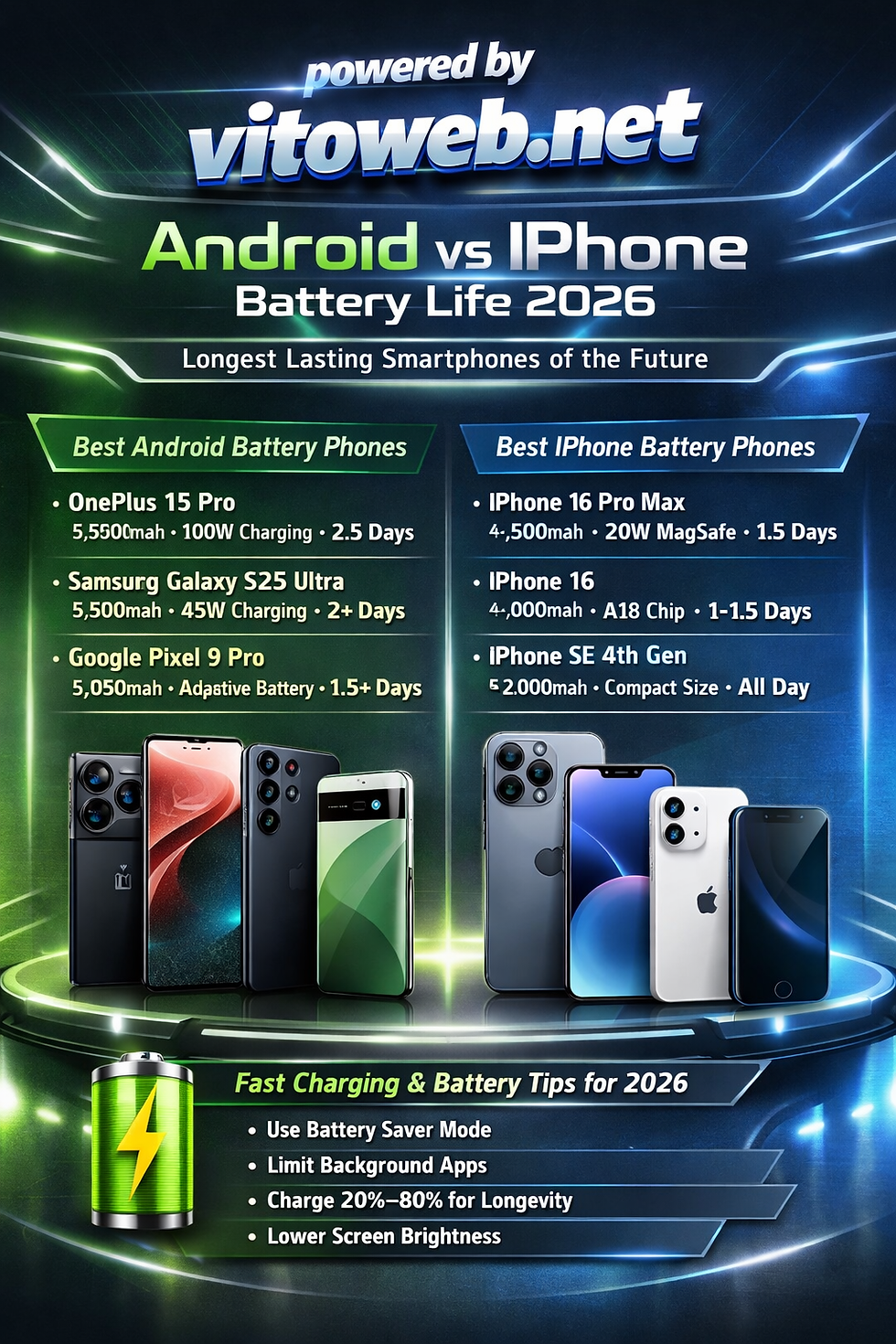
HowTo 1: Test Your Phone's Real-World Battery Life
Step 1: Fully charge to 100%, then unplug
Step 2: Set brightness to 50%, enable 5G (if your carrier supports it at your location)
Step 3: Use phone in your normal daily pattern for one full day
Step 4: At end of day, note remaining battery percentage
Step 5: Extrapolate: if 42% remains after 14 hours of mixed use, your phone has approximately 24 hours of battery at your usage pattern
Step 6: Compare to manufacturer's claimed hours — most manufacturers' "video streaming" claims run 50–70% longer than real mixed-use performance
Time: 1 full day
HowTo 2: Maximize Battery Life Settings on iPhone
Step 1: Settings → Battery → turn on Low Power Mode at 30%
Step 2: Settings → Display & Brightness → Auto-Brightness: On
Step 3: Settings → Battery → Battery Health → Optimized Battery Charging: On
Step 4: Settings → General → Background App Refresh: Off for non-essential apps
Step 5: Settings → Cellular → Voice & Data: Choose 5G Auto (not 5G On) — saves battery in weak 5G areas
Step 6: Settings → Display → Always On (if iPhone 16 Pro): Off when battery is priority
Time: 10 minutes
HowTo 3: Choose the Right Phone for Your Battery Needs
Step 1: Identify your primary use pattern — heavy user (streaming, gaming, social media 6+ hours/day) vs. light user (calls, messaging, occasional browsing)
Step 2: Heavy users: prioritize phones with 5,000mAh+ capacity — OnePlus 14, Realme GT 8T, Samsung Galaxy S25 Ultra
Step 3: Light users: any mid-range phone is adequate — Pixel 10a, iPhone 16, Galaxy A56
Step 4: Frequent travelers without charging access: prioritize fast charging — OnePlus 14 (150W), Realme GT 8T (130W)
Step 5: Wireless-only chargers: prioritize iPhone (MagSafe ecosystem) or Samsung (Qi2 ecosystem)
Step 6: Budget battery priority: Motorola Moto G Power at $249 — best battery per dollar available
Time: 15 minutes to decide
best phone battery life 2026
Android vs iPhone battery life, best battery Android phone 2026, iPhone battery life comparison, fast charging phones 2026, longest battery life phone
: Home → Blog → Smartphones → Battery Life → Best Phones Battery Life 2026
#BestPhoneBatteryLife #BatteryLife2026 #AndroidBattery #iPhoneBattery #AndroidVsiPhoneBattery #LongestBatteryPhone #FastCharging2026 #150WCharging #OnePlus14Battery #MotoBattery #MotoBatteryLife #PixelBattery #SamsungBattery #iPhone16Battery #BestAndroidBattery #BestPhoneBattery #RealmeGT8T #SuperVOOC #MagSafe #WirelessCharging #5GBattery #PhoneBatteryTips #BatteryCare #OptimizedCharging #BatteryHealth #PhoneCharging #FastCharge #QuickCharge #AndroidCharging #iPhoneCharging #BatteryComparison #SmartphoneBattery #MobileBattery #PhoneBatteryLife #AllDayBattery #LongLastingPhone #BudgetBattery #PremiumBattery #MidRangeBattery #BatteryTest #RealWorldBattery #BatteryTips #PhoneUsage #SmartphoneTips #TechComparison #PhoneComparison #AndroidOrIphone #iPhoneVsAndroid #BestPhone2026 #SmartphoneBuying #PhoneBuyingGuide #TechReview2026 #VitowebBlog #TechBlogger #AndroidSEO #iPhoneSEO #MobileGuide #ChargerSpeed #BatteryMath #mAh #BatteryRating #PhoneSpec #SpecComparison #PhoneReview #AndroidReview #iPhoneReview #TechContent2026 #PhoneTips #BatteryOptimization #LowPowerMode #ChargeSmarter #BatterySaver
Powered by Vitoweb.net
To display the Widget on your site, open Blogs Products Upsell Settings Panel, then open the Dashboard & add Products to your Blog Posts. Within the Editor you will only see a preview of the Widget, the associated Products for this Post will display on your Live Site.
Start your 14 days Free Trial to activate products for more than one post.
icon above or open Settings panel.
Please click on the


Comments