Google Gemma 4 Is Open-Source and Running on Your Phone: The Complete 2026 Guide to Local AI That Changes Everything
- vitowebnet izrada web sajta i aplikacija
- Apr 5
- 38 min read

Google Gemma 4 Open-Source 2026: Local AI for Phones, Servers & Raspberry Pi — Complete Guide | VitowebNET
Google's Gemma 4 is now fully open-source under Apache 2.0 — meaning free, private, offline AI on your phone, PC, Raspberry Pi, and enterprise servers. Here's everything developers, businesses, and curious users need to know.
Google Gemma 4 open-source local AI 2026
Gemma 4 Apache 2.0, local AI on phone 2026, run AI offline Gemma, Google DeepMind Gemma 4, open-source LLM 2026, Gemma vs Gemini, Gemma 4 models E2B E4B 26B 31B, AI on Raspberry Pi, private AI local deployment, open-source AI no cloud
Breaking News + Evergreen Authority Post
Author: VitowebNET Editorial Team
USA, Canada, UK, Australia, EU — Developers, IT professionals, business owners, AI enthusiasts globally
Why Gemma 4 Is More Significant Than Many Realize
Understanding Gemma: A Clear Comparison Between Gemini and Gemma
The Apache 2.0 Licensing Innovation: What Altered and Its Importance
Gemma 4 Model Series: E2B, E4B, 26B, 31B — Which Suits You Best?
Complete Abilities Overview: What Gemma 4 Is Truly Capable Of
The Gemmaverse: 400 Million Downloads and 100,000 Versions
Operating Gemma 4 on Your Phone: The Actual Process
Gemma 4 on Edge Devices: Raspberry Pi, Jetson Nano, IoT
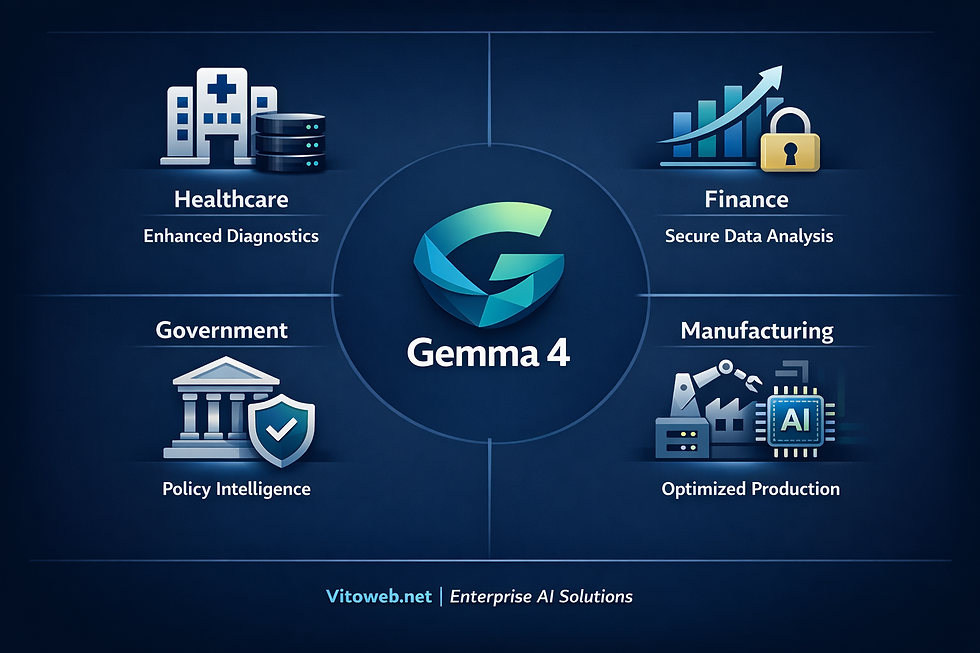
Business Applications: Healthcare, Finance, Government, Manufacturing
How to Begin Using Gemma 4 Immediately
Gemma 4 Compared to Rivals: Llama 3, Mistral, Phi-4, DeepSeek
Privacy & Security: The Growing Importance of Local AI in 2026
The Future of Local AI: What Gemma 4 Indicates for 2026 and Beyond
Vitoweb's AI Integration Solutions

Why Gemma 4 Is a Bigger Deal Than Most People Realize {#why-big-deal}
On April 2, 2026, Google's DeepMind research division released Gemma 4 — and did something that the AI industry has been slowly moving toward but never quite fully delivered: they made it truly, unambiguously, irrevocably open-source.
Not "open weights." Not "open access with restrictions." Not "free for non-commercial use." Fully open-source under the Apache 2.0 license — the gold standard of open-source licensing, used by everything from Apache HTTP Server to Android to TensorFlow.
The difference matters enormously, and we'll explain exactly why in the licensing section. But first, let's establish what you're actually getting: a four-model AI family capable of advanced reasoning, multimodal input (text, images, video, audio), agentic workflow execution, and code generation — running completely offline, on devices ranging from an Nvidia H100 server cluster down to a Raspberry Pi or Android smartphone.
The practical implications span every level of the technology stack:
For individual developers: You can build commercial products with Gemma 4, distribute them freely, modify the model however you want, and owe nothing to Google. No API costs, no usage caps, no terms of service that can change on you.
For enterprises: Healthcare providers with patient data. Financial institutions with proprietary trading data. Government agencies with classified information. All can now use frontier-class AI without a single byte of sensitive data leaving their premises.
For IoT and edge computing: Factories, hospitals, autonomous vehicles, smart cameras, industrial sensors — every device that needs intelligence but can't always reach the cloud now has access to a legitimately powerful AI that runs locally.
For privacy-conscious individuals: Running an AI that processes your questions entirely on your device, with no cloud component, no telemetry, no company logging your queries, is no longer a theoretical aspiration. It's an afternoon setup project.
At Vitoweb, we track AI developments with a focus on what they mean practically for businesses and individuals. Gemma 4 is one of the most significant open-source AI releases in the past two years — and this is your complete guide to understanding, evaluating, and deploying it.
2. What Is Gemma? Gemini vs. Gemma Explained Clearly {#gemma-explained}
Before diving into what's new with Gemma 4, it's worth clearly establishing what Gemma is — because the Gemini/Gemma distinction trips up even experienced technology professionals.
The Simple Explanation
Gemini is the AI you talk to. It's Google's flagship conversational AI — the chatbot at gemini.google.com, the AI integrated into Google Workspace, the assistant on Android. Gemini is a subscription-based closed product. You access it through Google's interface. Google's servers do the processing. Your data goes to Google's cloud.
Gemma is the AI engine you install. It's the underlying large language model technology — developed using the same research and technology base as Gemini — packaged for local deployment. You download Gemma. You run it on your hardware. Your data never leaves your device.
Think of it like this: Gemini is Netflix. Gemma is buying the Blu-ray. You get access to the same content (in this metaphor, the AI capability), but one requires ongoing access through a provider's infrastructure and the other you own outright.
The Technical Relationship
Both Gemma and Gemini were developed from the same foundational research at Google DeepMind. They share architectural principles, training approaches, and some training data. The key differences:
Factor | Gemini | Gemma |
Access model | API / Web interface | Download and run locally |
Cost | Subscription-based | Free (Apache 2.0) |
Data privacy | Processed on Google servers | Processed entirely on your device |
Customization | Limited (system prompts, fine-tuning in some tiers) | Complete freedom to modify model |
Commercial use | Restricted by terms of service | Unrestricted under Apache 2.0 |
Updates | Automatically updated by Google | You control which version you run |
Internet required | Yes | No (after initial download) |
Scale | Enterprise-grade cloud infrastructure | Hardware you own or control |
Why Google Releases Both
The strategy makes sense from multiple angles. Gemini is Google's revenue-generating AI product. Gemma is Google's strategy for developer ecosystem capture, academic research support, and competitive positioning against Meta's Llama family and other open-source alternatives.
By releasing Gemma, Google ensures that developers building AI-powered products consider Google's model architecture and training approach as their foundation — creating familiarity and compatibility that benefits Google's broader ecosystem even when the specific deployment doesn't generate direct revenue.
The Apache 2.0 Licensing Breakthrough: What Changed and Why It Matters {#apache-license}
The Problem with Previous Gemma Licensing
The original Gemma releases (generations 1, 2, and 3) were licensed under Google's own Gemma Terms of Use — a document that granted many freedoms but preserved Google's control in several important ways.
The previous license:
Permitted downloading and local use
Permitted modification for personal and research use
Required use only for "approved use categories" (Google-defined)
Restricted redistribution and commercial deployment in ways that made building products with Gemma legally complicated
Gave Google the ability to modify the terms affecting existing users
This approach allowed Google and others to describe Gemma as "open" — you could download it, run it, study it. But it was not "open-source" in the technical and legal sense that the software development community uses that term.
As ZDNET noted at the time of Gemma's original release: "Google's latest AI offering is an 'open model' but not 'open-sourced.' That difference matters."
What Apache 2.0 Actually Grants
The Apache 2.0 license is one of the most permissive and legally well-understood software licenses in existence. Under Apache 2.0, you receive:
Unrestricted use: Personal, commercial, enterprise — any purpose, any context, no royalties.
Redistribution rights: You can distribute Gemma 4 as part of your product, service, or device.
Modification rights: Change the model however you want. Fine-tune it. Merge it with other models. Create derivative works.
No use restrictions: Unlike Google's previous Gemma license, there are no "approved use categories." You decide what Gemma 4 is used for.
Patent protection for users: Apache 2.0 grants you a license to any patents covering contributions to the software. You can use Gemma 4 without fear that Google (or any other contributor) can later sue you for patent infringement based on your use.
Patent termination clause: If you sue anyone claiming the software infringes your patent, you automatically lose your Apache 2.0 license to the software. This provision protects the entire user community from patent trolling.
What Apache 2.0 Requires
The obligations under Apache 2.0 are minimal:
Include a copy of the Apache 2.0 license with any distribution
Provide attribution (credit to the original creators)
Indicate changes if you modified the software
That's essentially it. These obligations are trivial compared to what the license grants.
Why This Specific Change Is Historically Significant
The AI industry has been moving toward openness, but "open" has meant different things to different companies. Meta's Llama models use a custom license that's permissive but not technically Apache 2.0. Mistral uses Apache 2.0 for some models. Many "open-source" AI models have commercial restrictions.
Google switching Gemma 4 to pure Apache 2.0 represents:
A clear statement that Google wants Gemma in the maximum number of devices and products
Competitive pressure response to Meta, Mistral, and others gaining developer adoption
Acknowledgment that the previous "open but not open-source" approach was limiting adoption in enterprise and commercial contexts
For developers and businesses, this removes legal uncertainty that previously existed when building with Gemma. Apache 2.0 is a license that every corporate legal team knows and approves. The previous Gemma terms required custom legal review. Apache 2.0 does not.
Gemma 4 Model Family: E2B, E4B, 26B, 31B — Which Is Right for You? {#model-family}
Gemma 4 is not a single model — it's a carefully designed family of four models optimized for different deployment contexts. Understanding which model fits your use case is the first practical decision in any Gemma 4 deployment.
The Two Tiers: High-End Servers vs. Edge Devices
Google has divided the Gemma 4 family across two fundamental deployment categories:
Tier 1 — High-End Server Models (26B and 31B): Designed for deployment on powerful server infrastructure, typically with high-end NVIDIA GPUs (H100 class). These models prioritize maximum capability and quality over hardware efficiency.
Tier 2 — Edge/Mobile Models (E2B and E4B): Designed for mobile phones, IoT devices, single-board computers, and consumer PCs. These models prioritize efficiency, low latency, and minimal hardware requirements while maintaining meaningful capability.
Model Deep Dives
E2B — 2 Billion Parameters
What it is: The smallest, most efficient model in the Gemma 4 family. With 2 billion parameters, it represents a highly compressed AI capable of text, image, and audio processing.
Hardware requirements: Designed to run on smartphones, Raspberry Pi, Jetson Nano, and low-end consumer hardware. RAM requirements are modest enough for devices with 4–8GB total memory.
Context window: 128,000 tokens — surprisingly large for a model this small. This means the E2B can process a full short novel, an entire codebase, or a long technical document in a single prompt.
Key capabilities: Text generation, basic reasoning, image understanding, audio input (speech recognition), OCR from images, code generation.
Latency: Near-zero latency for simple queries on modern smartphone hardware. Designed with collaboration from Google Pixel team and chip manufacturers (Qualcomm Technologies, MediaTek) to optimize for mobile silicon.
Best for: On-device smartphone AI features, Raspberry Pi projects, edge IoT deployments, offline apps, privacy-sensitive consumer applications.
E4B — 4 Billion Parameters
What it is: The larger of the two edge models. The E4B provides significantly more reasoning depth and output quality than the E2B while remaining deployable on edge hardware with appropriate memory.
Hardware requirements: Modern smartphones with 6GB+ RAM, high-end Raspberry Pi variants, NVIDIA Jetson Nano/Xavier, consumer PCs, mini PCs.
Context window: 128,000 tokens — same as E2B.
Key capabilities: All E2B capabilities plus substantially improved reasoning, better code generation, more reliable instruction following, improved multilingual performance.
Best for: Power users on mobile, more complex edge deployments where quality matters more than absolute minimal footprint, developer workstations for personal/private AI, consumer PC-based local AI setups.
26B — 26 Billion Parameters
What it is: A Mixture of Experts (MoE) architecture model optimized for latency efficiency on high-end server hardware. Rather than activating all 26 billion parameters for every inference, the 26B model activates a relevant subset of its parameter set — reducing computational cost and latency while maintaining access to the full model's capabilities.
Hardware requirements: High-end GPU servers; NVIDIA H100 or equivalent. Not suitable for consumer hardware.
Context window: 256,000 tokens — long enough to process entire code repositories, long-form documents, or comprehensive knowledge bases in a single context.
Architecture advantage: The MoE approach means the 26B can operate with the effective compute cost of a smaller model on most queries, reserving full parameter activation for complex tasks. This enables lower inference costs in production deployments compared to a dense 26B model.
Best for: Enterprise private cloud deployments, medium-scale production APIs, organizations that need significantly better quality than edge models but can't justify the full resource cost of the 31B.
31B — 31 Billion Parameters
What it is: The flagship Gemma 4 model. A dense 31-billion-parameter model designed to maximize raw capability. Every parameter is active for every inference — the maximum quality, maximum capability configuration.
Hardware requirements: Top-tier GPU infrastructure: NVIDIA H100 (80GB), A100, or multi-GPU configurations. Enterprise server hardware.
Context window: 256,000 tokens.
Capability claim: Google's researchers state that Gemma 4 "outcompetes models 20x its size" — meaning the 31B competes with models at the 600B+ parameter scale in benchmark tasks. If accurate, this represents an extraordinary intelligence-per-parameter achievement.
Best for: Enterprise deployments requiring highest quality output; production AI systems where output quality directly affects business outcomes; research and fine-tuning base for specialized domain models.
Model Selection Guide
Deployment Context | Recommended Model | Why |
Smartphone AI features | E2B | Low memory; near-zero latency; offline |
Raspberry Pi project | E2B | Minimal compute requirements |
Consumer PC personal AI | E4B | Better quality; typical PC handles it |
Developer workstation | E4B | Good balance of quality and speed |
Edge IoT device | E2B or E4B | Depends on device specs |
Small business private server | 26B | Quality without maximum hardware cost |
Enterprise private cloud | 31B | Maximum quality; data sovereignty |
Research / fine-tuning | 31B | Best base model for specialized training |
Production API at scale | 26B (cost) or 31B (quality) | Depends on quality/cost priority |
Full Capabilities Breakdown: What Gemma 4 Can Actually Do {#capabilities}
Google has detailed a comprehensive capability set across all Gemma 4 models. Let's examine what each capability actually means in practice.
Advanced Reasoning and Multi-Step Planning
The claim: Gemma 4 is capable of "multi-step planning and deep logic."
What this means practically: The model can tackle problems that require breaking down a complex question into intermediate steps, evaluating each step, and arriving at a conclusion that depends on previous reasoning. Examples include:
Mathematical word problems requiring multiple calculations
Legal or regulatory analysis requiring multi-factor evaluation
Strategic planning tasks with multiple interdependent variables
Debugging complex code by tracing execution logic
For edge deployments (E2B/E4B), this represents a significant advance — previous small models struggled with multi-step reasoning in ways that limited practical utility. The 128K context window supports better reasoning by allowing the model to "hold more in mind" simultaneously.
Agentic Workflows
The claim: Gemma 4 can "deploy autonomous agents that interact with different tools and APIs, and execute workflows reliably."
What this means practically: Gemma 4 can be the AI brain behind an agent system — a program that receives a high-level goal, plans a sequence of steps, calls external tools (APIs, databases, file systems), evaluates results, and adjusts its approach until the goal is accomplished.
Real examples:
An on-device phone agent that can book appointments, send emails, and update calendar entries based on a voice instruction
A factory IoT agent that monitors sensor data, identifies anomalies, queries a maintenance database, and triggers work orders without cloud connectivity
A local development assistant that reads your codebase, runs tests, identifies failing tests, and proposes fixes
The agentic capability combined with the Apache 2.0 license means developers can build autonomous agent products using Gemma 4 as the foundation without licensing complications.
Vision and Audio: Full Multimodal Capability
All Gemma 4 models process video and images natively. The edge models (E2B, E4B) additionally support native audio input for speech recognition and audio understanding.
Vision capabilities include:
Variable resolution processing: The model handles images at their native resolution rather than requiring preprocessing to fixed sizes
OCR (Optical Character Recognition): Extract text from images with high accuracy — receipts, business cards, handwritten notes, documents
Chart and graph understanding: Interpret data visualizations and extract insights
Video frame analysis: Process video content for object detection, activity recognition, or scene description
Audio capabilities (E2B and E4B):
Speech recognition: Convert spoken audio to text with support for 140+ languages
Audio understanding: Analyze audio content beyond simple transcription — detecting sentiment, identifying speakers, understanding context
Practical implications of on-device multimodal AI:
Application | Capability Used |
Real-time document scanning | OCR from camera feed |
Voice-commanded smart home (offline) | Speech recognition |
Factory quality control | Visual defect detection |
Personal financial tracker | Receipt OCR → expense categorization |
Language learning app | Audio input → pronunciation assessment |
Accessibility tools | Image description for visually impaired |
Security camera analysis | Video frame → activity detection |
Extended Context Windows: 128K and 256K Tokens
The 128K token context window on E2B and E4B is remarkable for edge models. To put this in perspective:
128,000 tokens ≈ roughly 100,000 words of text
That's approximately the length of a full novel
Or an entire typical codebase for a medium-sized application
Or hundreds of pages of documentation
Passing a complete codebase, a lengthy contract, or an entire knowledge base to a model running on your phone — without internet connectivity — represents a capability boundary that simply didn't exist for edge AI before Gemma 4.
The 256K context window on server models extends this further, enabling processing of multi-document research synthesis, large codebases, or comprehensive regulatory databases in a single prompt.
Multilingual Support: 140+ Languages
Gemma 4 was natively trained on data representing 140+ languages. "Native" training (as opposed to translation-layer approaches) means the model genuinely understands linguistic nuance, idiom, and structure in each supported language rather than routing everything through English internally.
For global deployments — particularly in enterprise and IoT contexts — this means a single Gemma 4 deployment can serve users across diverse language communities without separate model instances or additional translation infrastructure.
Code Generation: Now Fully Offline
Gemma 4 supports complete offline code generation. This capability deserves special emphasis because:
Developer privacy: Code often contains proprietary business logic, unreleased product ideas, or security-sensitive implementation details. Running code generation entirely on-device means that proprietary code never reaches external servers.
Air-gapped environments: Government, defense, and high-security commercial environments often prohibit external network connections for development systems. Gemma 4 brings AI coding assistance to these environments for the first time.
Reliability: AI coding tools that depend on external APIs fail when API servers are slow, overloaded, or unavailable. Local Gemma 4 inference is only limited by your hardware — no external dependencies.
Cost at scale: API-based coding assistance costs accumulate significantly in large development organizations. Local deployment eliminates per-query costs entirely.

The Gemmaverse: 400 Million Downloads and 100,000 Variants {#gemmaverse}
The Scale of Adoption Already Achieved
The numbers Google has cited for Gemma's adoption since February 2024 are striking: over 400 million downloads and more than 100,000 derivative variants built by the community.
To put 400 million downloads in context: this represents a developer and researcher adoption rate that rivals the most successful open-source software projects of the past decade. Many of those downloads reflect not casual experimentation but production deployments, research projects, and commercial products built on Gemma's foundation.
The 100,000+ variants number is equally significant. A "variant" in this context refers to a Gemma model that has been modified — typically through fine-tuning on specialized datasets. These variants include:
Domain-specialized models:
Medical Gemma variants trained on clinical literature
Legal Gemma variants trained on case law and contracts
Financial Gemma variants trained on market data and financial documents
Code-specialized variants for specific programming languages
Language-enhanced variants:
Gemma variants fine-tuned for languages where the base model's performance was adequate but not optimal
Dialect-specific variants for regional language communities
Task-optimized variants:
Instruction-following variants optimized for chatbot applications
Reasoning-focused variants fine-tuned for mathematical problem-solving
Summarization variants optimized for document processing
What Gemma 4's Apache 2.0 License Means for the Gemmaverse
Previous Gemma models' community-developed variants existed in a somewhat legally ambiguous space. Under the old Gemma Terms of Use, redistribution was limited and commercial use of derivatives had restrictions.
Under Apache 2.0, every variant of Gemma 4 inherits full commercial freedom. The 100,000+ developer community that has been building on Gemma can now:
Distribute their variants freely
Build commercial products on them
Bundle them in devices and applications
License them under their own terms (with Apache 2.0 attribution)
This doesn't just benefit existing variants — it dramatically expands the commercial incentive to build new specialized variants, which will expand the ecosystem further.
The AI Ecosystem Effect
The Gemmaverse represents something important about how AI development is evolving. The frontier AI model research happens at well-funded labs (Google, Anthropic, OpenAI, Meta). But the last-mile specialization — adapting general models to specific industry contexts, languages, or use cases — increasingly happens in the open community.
Google's decision to release Gemma 4 under Apache 2.0 is an investment in this ecosystem effect: making Google's model architecture the foundation upon which a global community builds specialized solutions creates long-term technical alignment and familiarity with Google's approach even when individual deployments never touch Google's cloud services.
Running Gemma 4 on Your Phone: How It Actually Works {#on-phone}
The Technical Collaboration Behind On-Device Performance
Getting a 2 or 4-billion-parameter AI model to run at near-zero latency on a smartphone required significant collaborative engineering. Google DeepMind worked directly with:
Google Pixel team: Optimizing for Google's Tensor chips and Android's ML acceleration framework
Qualcomm Technologies: Ensuring compatibility and performance on Snapdragon-powered Android devices (the majority of Android flagship phones globally)
MediaTek: Optimizing for Dimensity chips (used in many mid-range and flagship Android devices)
This three-way collaboration ensures that Gemma 4's edge models run efficiently across the Android ecosystem's hardware diversity rather than being optimized for only one chip architecture.
What "Near-Zero Latency" Actually Means
The "near-zero latency" claim for mobile deployment refers to inference latency — the time between submitting a prompt and receiving the first tokens of a response.
For comparison:
Cloud AI (internet required): 200ms–2,000ms (network round trip + server queue + inference + response delivery)
Gemma 4 E2B on Pixel 10: Near-zero ms (local inference only; no network component)
For many applications — particularly voice assistants, real-time translation, and interactive tools — this latency difference is the difference between feeling responsive and feeling broken.
Practical Smartphone Applications Enabled by Gemma 4
Private Voice Assistant: A voice assistant that processes your commands entirely on-device. No query is sent to any server. "Call mom," "Set a reminder for 3pm," "What's my next meeting?" — all processed locally with no cloud dependency.
Offline Language Translation: Real-time camera translation (point phone at menu, sign, or document; get instant translation) without needing an internet connection. Critical for international travelers in areas with poor connectivity.
Private AI Keyboard: An AI keyboard that suggests completions, rewrites text, and adjusts tone entirely on your device. Unlike Gboard or similar AI keyboards that send keystrokes to servers, a Gemma 4-powered keyboard never shares your typing.
Smart Photo Analysis: "Find all photos where I'm with Sarah" or "Show me photos from restaurants" — processed on your device's photo library without uploading images to any cloud service.
Offline Document Processing: Scan a physical document, extract text (OCR), summarize it, and translate it — all without internet connectivity. Useful in healthcare, legal, and field service contexts.
Code Review on the Go: Review, explain, or suggest improvements for code directly on a developer's phone, with full privacy for proprietary code.
Gemma 4 on Edge Devices: Raspberry Pi, Jetson Nano, and IoT {#edge-devices}
Why Edge AI Changes Industrial and IoT Deployments
The traditional model for adding AI to industrial and IoT contexts has required cloud connectivity: sensor → data → cloud → AI inference → decision → actuator. This pipeline introduces:
Latency: Round-trip to cloud and back can take hundreds of milliseconds — unacceptable for real-time control systems
Bandwidth costs: Continuously streaming sensor data to the cloud is expensive
Reliability dependency: Any network interruption breaks AI capability
Data security risk: Sensitive operational data leaves the controlled environment
Ongoing API costs: Every AI inference generates a cloud usage charge
Gemma 4 on edge hardware inverts this: the AI lives on or adjacent to the device itself. Inference is local, latency approaches zero, bandwidth costs drop to near zero, network independence is complete, data sovereignty is maintained, and once hardware is purchased, inference is free.
Specific Hardware Compatibility
Raspberry Pi: The E2B model is specifically mentioned by Google as running on Raspberry Pi. The Raspberry Pi 5 (with 8GB RAM) provides sufficient resources for E2B inference at practical speeds. This opens AI capabilities to one of the most widely deployed single-board computers in the world — used in everything from educational projects to industrial prototyping to production IoT deployments.
NVIDIA Jetson Nano/Xavier: NVIDIA's Jetson platform is designed specifically for edge AI deployment, with integrated GPU acceleration. Gemma 4's E2B and E4B models take advantage of Jetson's GPU capabilities for significantly faster inference than CPU-only hardware. Jetson-based devices are commonly deployed in robotics, smart cameras, medical devices, and industrial automation.
Industrial IoT Gateways: Many industrial IoT gateways run Linux on x86 or ARM processors with 4–16GB RAM. Gemma 4's edge models fit comfortably in this environment, enabling AI processing at the network edge — aggregating and analyzing data from multiple sensors without cloud dependency.
Real-World Edge AI Applications
Factory Quality Control: Camera + Gemma 4 E2B/E4B running on a local GPU → real-time visual inspection of products on production line → immediate pass/fail decision → zero cloud latency → process continues at full speed.
Smart Agriculture: Soil sensors + weather data + Gemma 4 → local recommendations for irrigation, fertilization, and harvesting — works in remote fields with no cellular connectivity.
Medical Device Intelligence: Patient monitoring devices → Gemma 4 on embedded hardware → anomaly detection → immediate alert → no patient data ever transmitted externally → HIPAA compliance by architecture.
Retail Shelf Monitoring: Store cameras → Gemma 4 → shelf inventory assessment → automatic reorder trigger → operates independently of internet connectivity fluctuations.
Smart Building Systems: Environmental sensors → Gemma 4 → HVAC optimization → energy management → all decisions local → no dependence on cloud services.
Enterprise Use Cases: Healthcare, Finance, Government, Manufacturing {#enterprise}
Data Sovereignty: The Enterprise AI Dilemma — Solved
Many of the most impactful AI use cases exist in industries where data cannot leave controlled environments. Healthcare patient records. Financial trading models. Government classified information. Legal privileged communications. Until now, these organizations faced an impossible choice: either forgo AI benefits or accept unacceptable data sovereignty compromises.
Gemma 4 under Apache 2.0 resolves this dilemma.
The architecture that makes it possible:
Deploy Gemma 4 (26B or 31B for enterprise quality) on servers within your controlled environment. The model receives data, processes it, and returns results — all within your network perimeter. No data flows to Google, no API keys to manage, no cloud costs, no compliance exceptions required.
Healthcare Deployment
Clinical documentation: Gemma 4 deployed on hospital servers can assist physicians with clinical note drafting, discharge summary generation, and diagnosis coding — accessing patient records within the hospital's secure environment.
Medical imaging support: With Gemma 4's vision capabilities, a locally deployed model can assist radiologists in reviewing images, flagging anomalies, and generating preliminary report language — with zero patient data leaving the hospital network.
Drug interaction analysis: Pharmacy systems can query a local Gemma 4 deployment to check drug interactions against comprehensive pharmaceutical databases — faster than cloud-based alternatives, with no patient medication history transmitted externally.
Regulatory compliance landscape:
HIPAA (US): Local AI deployment inherently complies with HIPAA's data security requirements — PHI never leaves covered entity control
GDPR (EU): On-premises AI processing satisfies data residency and processing restrictions for health data
NHS Digital Standards (UK): Local processing addresses data sovereignty requirements for NHS patient data
Financial Services Deployment
Proprietary trading analysis: Trading firms can deploy Gemma 4 to analyze market data, generate trading signals, and evaluate position risks — without revealing proprietary trading strategies to external cloud providers.
Client communication analysis: Compliance teams can use local Gemma 4 deployments to review advisor-client communications for regulatory compliance issues — without transmitting confidential client data externally.
Fraud detection: Real-time transaction analysis using Gemma 4's reasoning capabilities, deployed on local inference hardware — the fastest possible fraud detection with no external data transmission.
Document processing: Loan applications, contracts, financial statements — Gemma 4's OCR and document understanding capabilities process these entirely within the institution's systems.
Government and Defense
For government agencies handling classified or sensitive information, cloud-based AI has been categorically unusable in many contexts. Gemma 4's open-source availability enables:
Air-gapped deployment: Installation in completely isolated networks with no internet connectivity
Custom fine-tuning: Training on classified domain knowledge without that knowledge leaving secure facilities
Supply chain security: Apache 2.0 license allows complete audit of the model's code and modification before deployment — addressing supply chain concerns
Sovereign AI: Governments can fork Gemma 4, adapt it to their specific requirements, and control their AI stack entirely
Manufacturing and Industrial Applications
Predictive maintenance: Local Gemma 4 deployment analyzes machinery sensor data, maintenance records, and operational patterns to predict failures before they occur — with no manufacturing operational data transmitted to external cloud services.
Process optimization: Real-time analysis of production metrics, energy consumption, and quality data to suggest process adjustments — latency measured in milliseconds rather than seconds.
Technical documentation intelligence: Field technicians accessing technical manuals, troubleshooting guides, and schematics through a Gemma 4-powered interface that understands context and answers specific questions — works in factory environments with unreliable WiFi.
How to Get Started with Gemma 4 Right Now {#get-started}
Getting Gemma 4 on Your PC (LM Studio — Easiest Method)
Step 1: Download LM Studio from lmstudio.ai (free; available for Windows, macOS, Linux)
Step 2: Install and open LM Studio. The home screen shows the model search interface.
Step 3: Search "Gemma 4" in the search bar. Select your preferred model variant (E4B for most consumer PCs; E2B if RAM is limited).
Step 4: Click Download. LM Studio fetches the quantized model from Hugging Face (typically 2–6GB depending on variant and quantization level).
Step 5: After download, click "Load Model" — the model loads into RAM.
Step 6: Switch to the Chat tab. Start chatting with Gemma 4 locally.
RAM requirements for each model:
E2B (Q4 quantized): approximately 2–3GB RAM
E4B (Q4 quantized): approximately 3–5GB RAM
26B (Q4 quantized): approximately 14–18GB RAM (requires significant hardware)
31B (Q4 quantized): approximately 18–22GB RAM (high-end hardware)
Getting Gemma 4 via Ollama (Developer Method)
Step 1: Install Ollama from ollama.ai (free)
Step 2: Open Terminal or Command Prompt
Step 3: Run: ollama pull gemma4:e4b (or e2b, 26b, 31b)
Step 4: After download completes, run: ollama run gemma4:e4b
Step 5: Begin chatting directly in the terminal
Using Ollama as an API: Ollama exposes a local API at http://localhost:11434 that accepts the same request format as OpenAI's API. This means any application built for OpenAI's API can point to your local Ollama instance and use Gemma 4 instead — with zero modification to application code and zero API costs.
Getting Gemma 4 on Android (Developer Preview)
Google is releasing on-device Android deployment through:
Google AI Edge SDK: For developers building Android apps with on-device AI
Android ML Kit: Integration point for Gemma 4 in standard Android application development
MediaPipe LLM Inference API: Higher-level API abstracting model management
Consumer-facing Gemma 4 on Android will increasingly appear through Google's own Pixel features and third-party apps leveraging these SDKs.
Accessing Gemma 4 via Google AI Studio (Cloud)
For developers who want to experiment with the larger models (26B, 31B) without enterprise hardware:
Google AI Studio (aistudio.google.com) provides API access to Gemma 4 models. While this is cloud-based rather than local, it allows:
Testing and development before local deployment
Access to the larger models from any hardware
Fine-tuning experiments without local GPU infrastructure
Fine-Tuning Gemma 4 for Your Use Case
Under Apache 2.0, you're free to fine-tune Gemma 4 on your own data. Tools for fine-tuning include:
Hugging Face Transformers: Industry-standard fine-tuning library; extensive Gemma 4 support
Unsloth: Efficient fine-tuning library that significantly reduces memory requirements; popular for fine-tuning on consumer hardware
Google's Fine-Tuning Guide: Available at ai.google.dev/gemma/docs/core/tune_for_task
Fine-tuning on specialized domain data with Gemma 4's Apache 2.0 base produces specialized models you own completely and can deploy, distribute, and commercialize without restriction.
Gemma 4 vs. Competitors: Llama 3, Mistral, Phi-4, DeepSeek {#competition}
The Open-Source LLM Landscape in 2026
Gemma 4 enters a competitive open-source LLM ecosystem. Here's how it compares to the major alternatives:
Factor | Gemma 4 (E4B) | Llama 3 (8B) | Mistral 7B | Phi-4 (14B) | DeepSeek V3 |
License | Apache 2.0 | Meta Llama License | Apache 2.0 | MIT | MIT |
Parameters | 4B edge / 31B server | 8B–70B | 7B | 14B | Large (MoE) |
Multimodal | Yes (text, image, video, audio) | Text only (base) | Text primarily | Text + some vision | Text + code |
On-device mobile | Specifically optimized | Possible but not optimized | Possible | Possible | Not optimized |
Context window (edge) | 128K | 128K | 32K | 16K | 64K |
Code generation | Yes (all models) | Yes | Yes | Excellent | Excellent |
Audio input | Yes (E2B, E4B) | No | No | No | No |
140+ languages | Yes (native training) | Limited | Limited | Good | Limited |
Commercial use | Unrestricted (Apache 2.0) | Restricted (Meta license) | Unrestricted | Unrestricted | Unrestricted |
Google ecosystem integration | Native | None | None | None | None |
Where Gemma 4 Leads
Multimodal edge capability: No competing model combines native audio input, video understanding, and text processing in a 2–4B parameter package. The E2B and E4B are uniquely positioned for IoT and mobile multimodal applications.
On-device optimization: The explicit collaboration with Qualcomm and MediaTek for mobile deployment is more focused than any competitor's mobile strategy.
Extended context for edge models: 128K context in E2B/E4B is competitive with or better than models several times their size from other families.
Native multilingual training: 140+ natively trained languages versus competitors' English-dominant training with multilingual coverage as secondary.
Where Competitors Still Lead in Some Areas
Code generation: Phi-4 and DeepSeek models specifically optimized for coding tasks still outperform Gemma 4 on narrow coding benchmarks. For pure code generation use cases, these alternatives deserve evaluation.
Llama 3 ecosystem maturity: Meta's Llama 3 has been available longer and has a larger ecosystem of fine-tunes, tools, and deployment guides. Gemma 4's ecosystem will catch up but takes time.
Mistral for European deployment: Mistral AI is a European company with data sovereignty considerations built into its corporate DNA. European enterprises with specific jurisdiction preferences may continue to favor Mistral models.
Privacy and Security: Why Local AI Matters More Than Ever in 2026 {#privacy-security}
The Data Privacy Equation of Cloud AI
Every time you submit a query to a cloud AI service — ChatGPT, Gemini, Claude, Copilot — that query travels to a server operated by the AI provider. There it is:
Processed by the AI model (inference)
Potentially logged for debugging and quality monitoring
Potentially reviewed by human trainers for model improvement
Stored according to the provider's retention policies
Subject to the provider's privacy policy, which can change
For casual queries — "write me a poem about autumn" — this data flow is inconsequential. For queries that include sensitive information — medical symptoms, financial details, legal situations, proprietary business data, personal relationship problems — this data flow has real implications.
What Local AI Eliminates
Running Gemma 4 locally eliminates every external data exposure vector:
No internet required: After downloading the model once, inference requires no internet connection. Queries never leave your device.
No logging: There is no external system to log your queries. Local inference produces local results — nothing recorded anywhere outside your hardware.
No training data collection: Your queries cannot be used to train future versions of the model. Apache 2.0 grants you rights to the model; it creates no obligation to contribute data back.
No corporate policy risk: Cloud AI providers can change their privacy policies. Your local Gemma 4 deployment operates under your policies, not theirs.
No breach risk (external): Data that never leaves your device cannot be exposed in a cloud provider's data breach.
Gemma 4's Security Architecture
Google states that Gemma models "Undergo the same rigorous infrastructure security protocols as our proprietary models." For an open-source model, this means:
The same security-focused training practices used for Gemini
Safety evaluations for harmful content generation
Documented model card with training data, evaluation results, and known limitations
The Apache 2.0 license additionally enables independent security auditing — any organization can review the model architecture and training code, something not possible with closed models.
The Healthcare Privacy Case Study
Consider a hospital deploying Gemma 4 26B on-premises for clinical documentation assistance. The privacy architecture:
Physician dictates notes; Gemma 4 converts speech to text (E4B on endpoint device)
Draft note sent to on-premises 26B deployment for clinical language refinement
Finished note returned to physician for review and signature
Patient data travels: endpoint device → on-premises server → back to endpoint device
External data transfers: zero
Compare to cloud AI: physician's dictation, patient identifiers, diagnosis codes, medication details, and clinical observations all transmitted to external cloud infrastructure.
The difference isn't theoretical — it's the difference between deployment in regulated healthcare environments and deployment being legally impossible.
The Future of Local AI: What Gemma 4 Signals for 2026 and Beyond {#future}
The Trend Gemma 4 Accelerates
Gemma 4 doesn't represent an isolated development — it's the clearest signal yet of a structural shift in how AI capability is distributed. The direction of travel is toward:
Smaller, more efficient models: Gemma 4 demonstrating competitive performance with models "20x its size" reflects a broader industry trend. Each generation of model training techniques produces models that achieve similar or better results with fewer parameters. The performance gap between edge and server models is narrowing.
On-device as default for privacy-sensitive tasks: As on-device models improve, the expectation that private data must be processed in the cloud weakens. Expect future smartphone operating systems to route sensitive queries to on-device models by default.
Open-source AI as infrastructure: The Apache 2.0 licensing of Gemma 4 positions AI models the way Linux positioned operating systems — as infrastructure that underpins an ecosystem rather than a product to be licensed.
Hardware optimization for AI at the edge: The Qualcomm and MediaTek collaborations on Gemma 4 reflect a broader industry direction. Chip designers are increasingly building AI acceleration directly into mobile and edge silicon, making on-device AI faster and more energy-efficient with each hardware generation.
What This Means for Developers and Businesses in 2026
Build with confidence: Apache 2.0 licensing means product decisions made with Gemma 4 today won't be disrupted by licensing changes tomorrow. This stability is critical for long-term product planning.
Private AI products are now viable: Products that process sensitive user data with on-device AI — previously requiring custom model development — can now be built on Gemma 4. This opens market opportunities in healthcare, legal, financial, and personal data categories that cloud AI couldn't serve.
Lower AI operational costs: For high-volume AI applications, the difference between API costs and local inference costs is enormous. Gemma 4 enables AI features that would be prohibitively expensive to serve at scale through cloud APIs.
Competitive differentiation through privacy: As privacy concerns around AI grow, products that can credibly claim "all AI processing happens on your device" have a genuine competitive differentiator. Gemma 4 makes this claim achievable and verifiable.
Build Your AI Advantage With the Right Foundation
At Vitoweb, we help businesses and developers navigate the rapidly evolving AI landscape — from evaluating open-source models like Gemma 4 to implementing production AI systems that actually work.
Gemma 4's release under Apache 2.0 opens genuine opportunities for organizations that previously couldn't use AI due to data sovereignty, privacy, or cost constraints. But choosing the right model, deployment architecture, and integration approach requires expertise that goes beyond reading documentation.
Service | What We Provide | Ideal For |
AI Strategy Consulting | Evaluate open-source vs. cloud AI for your specific use case | Businesses assessing AI implementation options |
Local AI Deployment | Set up and configure Gemma 4 (or other local LLMs) in your environment | Organizations needing private, on-premises AI |
AI Integration Development | Build AI features into your existing products and workflows | Developers and product teams |
Privacy & Compliance Advisory | Ensure AI implementation meets HIPAA, GDPR, and sector requirements | Regulated industries |
Fine-Tuning Services | Adapt Gemma 4 to your domain-specific use case | Organizations needing specialized AI |
SEO & Content with AI | Build authority content optimized for both search and AI discovery | Businesses growing online presence |
Ready to deploy private, powerful AI without cloud dependency?✅ Explore Vitoweb Services✅ Read the Vitoweb Blog✅ View Our Portfolio✅ Join Our Community
Case Study: Local AI Deployment for a Mid-Size Healthcare Practice
The challenge: A 12-physician group practice wanted AI-assisted clinical documentation but couldn't use cloud AI due to HIPAA concerns about transmitting PHI to external servers. Previous solutions required either accepting data sovereignty risk or foregoing AI entirely.
The VitowebNET approach:
Evaluated Gemma 4 26B vs. competitor models for clinical documentation quality
Designed on-premises server architecture (2× NVIDIA RTX 4090; 128GB RAM)
Deployed Gemma 4 26B fine-tuned on de-identified clinical documentation examples
Integrated with existing EHR system through local API
Implemented access controls, audit logging, and model output review workflows
Documented deployment architecture for HIPAA compliance documentation
The result: Physicians reduced documentation time by an average of 40 minutes per day. Zero PHI transmitted to external systems. HIPAA compliance maintained. Total ongoing AI operational cost: $0 in API fees. Hardware ROI achieved within 6 months through physician time savings.
(This Article):Google Gemma 4 Open-Source Local AI — Complete 2026 Guide
Cluster A: Gemma 4 Technical Guides
Cluster B: Local AI & Privacy 7. Why Local AI Is the Future of Private Computing 8. Open-Source AI: The Complete Beginner's Guide 2026 9. Running AI Locally vs Cloud AI: Privacy, Cost, and Performance Compared 10. How to Build a Completely Private AI Setup in 2026 11. AI Privacy Risks You Need to Know in 2026 12. GDPR and Local AI: How On-Premises Deployment Solves Compliance
Cluster C: Enterprise & Industry AI 13. Local AI in Healthcare: HIPAA-Compliant AI Deployment Guide 14. AI for Financial Services: Data Sovereignty Without Sacrificing Intelligence 15. Edge AI for Manufacturing: IoT Intelligence Without the Cloud 16. Government AI: Air-Gapped Deployment and Data Security 17. Apache 2.0 License Explained for AI Model Deployment 18. How to Build a Custom AI Chatbot with Gemma 4 and Ollama
Cluster D: Open-Source AI Ecosystem 19. Google DeepMind Explained: The Research Behind Gemma and Gemini 20. Gemini vs Gemma vs ChatGPT: Which AI Should You Use? 21. The Open-Source AI Revolution: How Models Like Gemma Are Changing Tech 22. MCP (Model Context Protocol) + Gemma 4: Build Powerful Local AI Agents 23. Best Hardware for Running Local AI Models in 2026 24. AI on the Edge: Complete Guide to On-Device Machine Learning 2026
Cluster E: Vitoweb AI & Digital Services 25. How Vitoweb Builds SEO-First AI Content Systems 26. LLM Optimization: How to Get Your Content Found by AI 27. AI on a Budget: How to Use AI Without Breaking the Bank 28. Best Free AI Tools for Small Businesses in 2026 29. How to Build an AI-Powered Business on $100/Month 30. The Future of AI Privacy: What's Coming in 2027
FAQ Table 1: What Is Gemma 4 and How Does It Work?
Question | Answer |
What is Google Gemma 4? | Gemma 4 is Google DeepMind's latest open-source large language model family, released under the Apache 2.0 license. It includes four model variants (E2B, E4B, 26B, 31B) designed for deployment from smartphones to enterprise servers — entirely offline and without cloud dependency. |
What is the difference between Gemma and Gemini? | Gemini is Google's subscription-based cloud AI chatbot. Gemma is the underlying open-source model that runs locally on your hardware. Both use similar research foundations, but Gemini requires internet and a subscription; Gemma is free and runs on your own devices. |
Is Gemma 4 really free to use commercially? | Yes. Under the Apache 2.0 license, Gemma 4 can be used for any purpose — personal, commercial, or enterprise — without royalty fees or use restrictions. Attribution is required when distributing. |
What hardware do I need to run Gemma 4? | The E2B model runs on smartphones and Raspberry Pi. The E4B runs on modern consumer PCs (8GB+ RAM). The 26B and 31B require high-end GPU server hardware (NVIDIA H100 class). |
Can Gemma 4 run completely offline? | Yes. After the initial model download, Gemma 4 requires no internet connection for inference. All processing happens on your local hardware. |
What languages does Gemma 4 support? | Gemma 4 was natively trained on 140+ languages — meaning the model genuinely understands these languages rather than routing through translation. |
What is the context window of Gemma 4? | Edge models (E2B, E4B): 128,000 tokens. Server models (26B, 31B): 256,000 tokens. These windows allow processing of entire codebases, long documents, or comprehensive knowledge bases in a single prompt. |
What is Apache 2.0 and why does it matter for AI models? | Apache 2.0 is one of the most permissive open-source licenses. For Gemma 4, it means unrestricted commercial use, full redistribution rights, freedom to modify, and no "approved use categories" — the most developer-friendly licensing possible. |
FAQ Table 2: Deployment and Technical Questions
Question | Answer |
How do I run Gemma 4 on my Windows PC? | Install LM Studio (free, from lmstudio.ai), search for "Gemma 4," download the E4B model, and start chatting. No technical knowledge required. The E4B model runs on most modern PCs with 8GB+ RAM. |
How do I run Gemma 4 via command line? | Install Ollama from ollama.ai. Run: ollama pull gemma4:e4b to download, then ollama run gemma4:e4b to start. Ollama also exposes a local API for application integration. |
Can Gemma 4 be used as a replacement for the OpenAI API? | Yes. Ollama exposes a local API compatible with OpenAI's API format. Applications built for the OpenAI API can point to a local Ollama/Gemma 4 instance with minimal code changes, eliminating API costs. |
How long does it take to download and set up Gemma 4? | On a fast connection, E4B model download takes 5–15 minutes. LM Studio or Ollama setup takes under 10 minutes. First inference run within 30 minutes of starting. |
Can I fine-tune Gemma 4 on my own data? | Yes. Under Apache 2.0, you have full rights to fine-tune Gemma 4 on custom datasets. Tools like Hugging Face Transformers and Unsloth support Gemma 4 fine-tuning. The resulting model is yours to own and distribute. |
What is quantization and why does it matter for running Gemma 4? | Quantization reduces model file size and RAM requirements by representing model weights in lower-precision formats (e.g., 4-bit instead of 32-bit). Q4_K_M quantized Gemma 4 E4B requires ~3–4GB RAM vs. ~16GB for full precision, enabling deployment on consumer hardware with modest quality trade-off. |
Does Gemma 4 support GPU acceleration on consumer hardware? | Yes. NVIDIA GPUs (via CUDA), AMD GPUs (via ROCm), and Apple Silicon (via Metal) all provide hardware acceleration for Gemma 4 inference through LM Studio and Ollama. GPU acceleration dramatically increases inference speed. |
How does Gemma 4 compare to ChatGPT for everyday tasks? | For most everyday tasks on the E4B model, quality is comparable to GPT-3.5 and competitive with GPT-4 in certain areas. Server models (26B, 31B) approach GPT-4 level performance. The trade-off is privacy and zero cost vs. the polished UX of ChatGPT. |
FAQ Table 3: Enterprise, Privacy, and Use Cases
Question | Answer |
Can I use Gemma 4 in a HIPAA-compliant healthcare deployment? | Yes. On-premises Gemma 4 deployment processes patient data entirely within the healthcare organization's infrastructure. No PHI reaches external servers. This architecture is compatible with HIPAA's Security Rule requirements, though full compliance depends on additional technical and administrative controls. |
Is Gemma 4 suitable for processing financial data? | Yes. Local deployment means proprietary trading strategies, client financial data, and transaction information never leave the institution's controlled environment — addressing key financial services data sovereignty requirements. |
Can I build and sell a product using Gemma 4? | Yes, without restriction under Apache 2.0. You can bundle Gemma 4 in hardware devices, integrate it in software products, and sell those products commercially. Attribution to Google is required; no royalty payments. |
What are the security considerations for deploying Gemma 4? | Key security considerations: secure the inference server/device against unauthorized access, implement input/output filtering if deploying publicly, keep model weights secure if proprietary fine-tuning has been applied, audit model outputs in regulated contexts. Google states Gemma models undergo the same security protocols as proprietary Gemini models. |
Can Gemma 4 run in an air-gapped environment? | Yes. After downloading the model files, Gemma 4 operates with zero network connectivity. This makes it suitable for classified government environments, secure industrial systems, and any deployment context where network isolation is required. |
What happens if I violate Apache 2.0 terms? | Apache 2.0 is permissive — the obligations are minimal (attribution, include license). Patent-related violations (filing patent lawsuits based on the software) result in automatic license termination. Misrepresenting authorship violates Apache 2.0. Most legitimate commercial use is entirely covered. |
Is there a cloud version of Gemma 4 for testing before local deployment? | Yes. Google AI Studio (aistudio.google.com) provides API access to Gemma 4 models for development and testing before committing to local deployment infrastructure. |
How-To Guide 1: Run Gemma 4 Locally on Any PC in Under 30 Minutes
Goal: Get Gemma 4 running entirely locally on your Windows, Mac, or Linux computer
Step 1 — Download LM Studio (5 minutes) Go to lmstudio.ai and download LM Studio for your operating system. Install it like any standard application. LM Studio provides a graphical interface for managing and running local AI models.
Step 2 — Search for Gemma 4 (2 minutes) Open LM Studio. In the search bar at the top, type "gemma 4" (or "google/gemma4"). Browse the results — you'll see different model variants and quantization levels. For most users: select "gemma-4-e4b" with Q4_K_M quantization.
Step 3 — Download the Model (10–20 minutes depending on connection) Click the download button next to your selected model. LM Studio downloads from Hugging Face and shows download progress. File size for E4B Q4_K_M: approximately 3–4GB.
Step 4 — Load the Model (1–2 minutes) After download completes, select the model and click "Load Model." LM Studio loads the model into RAM. You'll see a green indicator when ready.
Step 5 — Start Chatting Navigate to the Chat tab. Type any prompt. Gemma 4 processes it entirely on your device — no internet connection needed after the initial download. Response speed depends on your hardware (GPU if available; CPU otherwise).
Step 6 — Enable GPU Acceleration (if you have a compatible GPU) LM Studio Settings → Hardware → Select GPU layers. Moving layers to GPU dramatically increases inference speed. Start with half your GPU layers and increase until you run out of VRAM.
Tip: For privacy-critical use, verify LM Studio is not sending telemetry: Settings → Privacy → Disable analytics.
How-To Guide 2: Deploy Gemma 4 as a Local API Server for Applications
Goal: Run Gemma 4 as a local API that any application can query — replacing cloud AI APIs with zero-cost, private local inference
Step 1 — Install Ollama Download from ollama.ai. Install as a service that runs in the background.
Step 2 — Pull Gemma 4 Model Open Terminal/Command Prompt and run: ollama pull gemma4:e4b Ollama downloads and manages the model automatically.
Step 3 — Verify Ollama is Running Run: ollama list — should show gemma4:e4b in the model list. Run: curl http://localhost:11434/api/tags — should return a JSON list of available models.
Step 4 — Test the API Run this command: curl http://localhost:11434/api/generate -d '{"model": "gemma4:e4b", "prompt": "Explain quantum computing in one paragraph"}' You should receive a streaming response from Gemma 4.
Step 5 — Integrate with OpenAI-Compatible Applications Ollama exposes an OpenAI-compatible endpoint at: http://localhost:11434/v1 In any app that uses the OpenAI Python SDK, change:
Base URL to http://localhost:11434/v1
API key to ollama (placeholder; not checked)
Model name to gemma4:e4b The application now uses Gemma 4 locally with zero API costs.
How-To Guide 3: Set Up a Private, On-Device AI for Healthcare or Business Use
Goal: Implement a private, data-sovereign AI deployment suitable for HIPAA, GDPR, or proprietary business data contexts
Step 1 — Assess hardware requirements For business/enterprise use: recommend 26B or 31B model. Hardware requirement: server with minimum 2× NVIDIA RTX 4090 (48GB VRAM combined) or equivalent; 128GB system RAM; NVMe storage.
For small organization: E4B model on a high-spec workstation (64GB RAM; NVIDIA RTX 4090; NVMe SSD) provides significantly better results than any cloud AI for common document and communication tasks.
Step 2 — Install LM Studio (workstation) or Ollama (server) For server deployment, Ollama provides better API integration. Install on server; configure to listen on local network (not internet-facing).
Step 3 — Network isolation Ensure your AI inference server has no direct internet connectivity. Data flows only within your private network. This architectural control is the foundation of your data sovereignty claim.
Step 4 — Access control Configure authentication for the Ollama API (production deployments). Use network-level access controls (firewall rules) to restrict which systems can query the AI server.
Step 5 — Audit logging Implement logging of all queries and responses at the application layer. This provides the audit trail necessary for compliance documentation (HIPAA, GDPR data processing records).
Step 6 — User interface Deploy Open WebUI (github.com/open-webui/open-webui) — a ChatGPT-like interface that connects to your local Ollama server. Staff interact through a familiar chat interface; all processing stays local.
Step 7 — Documentation Document your deployment architecture for compliance purposes. Key elements: data flow diagram showing no external data transmission, access controls, model provenance (Apache 2.0 Gemma 4), retention policies for queries/responses.
@type: BreadcrumbListItem 1: Home — https://vitoweb.netItem 2: Blog — https://vitoweb.net/blogItem 3: AI & Technology — https://vitoweb.net/blog/category/ai-technologyItem 4: Google Gemma 4 Guide 2026 — https://vitoweb.net/blog/google-gemma-4-open-source-local-ai-guide-2026
FAQ Schema Input
@type: FAQPage
Q1: What is Google Gemma 4?A1: Gemma 4 is Google DeepMind's open-source AI model family, released under the Apache 2.0 license in April 2026. It includes four models (E2B, E4B, 26B, 31B) that run locally on hardware ranging from smartphones to enterprise servers — with no internet connection required and no data sent to Google's cloud.
Q2: What is the difference between Gemma and Gemini?A2: Gemini is Google's subscription-based cloud AI chatbot. Gemma is the free, open-source model that runs on your own hardware. Both use similar underlying technology, but Gemma processes all data locally while Gemini sends data to Google's servers.
Q3: Can Gemma 4 run on a phone?A3: Yes. The E2B and E4B models are specifically optimized for smartphones, with near-zero latency on modern Android devices. Google collaborated with Qualcomm and MediaTek to optimize performance on mobile chips.
Q4: Is Gemma 4 free for commercial use?A4: Yes. The Apache 2.0 license grants unrestricted commercial use with no royalties. You can build products with Gemma 4, distribute them, and sell them without any fee to Google.
Q5: Can Gemma 4 be used in HIPAA-compliant healthcare applications?A5: Yes. On-premises Gemma 4 deployment processes all data within the healthcare organization's infrastructure, with no patient data transmitted to external servers — compatible with HIPAA's security requirements.
HowTo Schema 1: Run Gemma 4 Locally
@type: HowTo
name: How to Run Gemma 4 Locally on Your PC in Under 30 Minutes
description: Step-by-step guide to running Google's Gemma 4 AI model entirely on your local computer using LM Studio
estimatedCost: Free
totalTime: PT30M
Steps:
Download LM Studio from lmstudio.ai
Search for "gemma 4" in LM Studio's model browser
Download gemma-4-e4b (Q4_K_M quantization)
Load the model in LM Studio
Open the Chat tab and begin local AI conversations
Enable GPU acceleration in settings for faster inference
HowTo Schema 2: Deploy Gemma 4 as Local API
@type: HowTo
name: How to Deploy Gemma 4 as a Local API Server
description: Set up Gemma 4 as an OpenAI-compatible local API that applications can query at zero cost
estimated
Cost: Free
totalTime: PT20M
Steps:
Install Ollama from ollama.ai
Run: ollama pull gemma4:e4b
Verify Ollama is running: ollama list
Test the API endpoint at localhost:11434
Configure applications to use localhost:11434/v1 as OpenAI base URL
Replace cloud AI API calls with local Gemma 4 inference
HowTo Schema 3: Private Enterprise AI Deployment
@type: HowTo
name: How to Deploy Gemma 4 for HIPAA/GDPR Compliant Private AI
description: Steps for implementing a data-sovereign, on-premises AI deployment using Gemma 4 for healthcare or business use
estimatedCost: Hardware cost only (no software licensing)
totalTime: PT4H
Steps:
Assess hardware requirements for target model (26B or 31B for enterprise)
Install Ollama on an isolated server
Configure network isolation to prevent external data transmission
Implement access controls and authentication
Set up audit logging for compliance documentation
Deploy Open WebUI for staff interface
Document deployment architecture for compliance records
"Google just made a powerful AI model free — and it runs entirely on your phone with zero internet. Here's what Gemma 4 means for everyone."
"Your hospital, your law firm, your startup can now run frontier AI without sending a single byte to the cloud. Gemma 4 changes everything."
"400 million downloads. 100,000 variants. And now it's truly open-source. The Gemma 4 moment has arrived."
"ChatGPT costs money. Cloud AI takes your data. Gemma 4 is free, private, and runs on a Raspberry Pi. The choice just got a lot clearer."
"Google's Gemma 4 just outcompeted models 20x its size — and you can run it offline on your phone. The local AI era is here."
Breaking news angle: release announced April 2, 2026 — publish immediately for freshness signals
Large hero image: phone + Raspberry Pi + server visual with "FREE & OPEN SOURCE" callout
Update article as community benchmarks, how-to tutorials, and fine-tuned variants emerge
E-E-A-T: link to Google DeepMind announcement blog, cite researchers Clement Farabet and Olivier Lacombe by name
Google Gemma 4 open source | local AI no internet | run AI on phone offline | Gemma 4 Raspberry Pi | private AI without cloud | Apache 2.0 AI model | free open source LLM 2026 | on-device AI 2026 | Google DeepMind model | local LLM deployment
Primary / High Volume: #GoogleAI #OpenSourceAI #LocalAI #Gemma4 #AIPrivacy #MachineLearning #LLM #ArtificialIntelligence #DeepMind #AITools
Secondary / Growing: #Gemma4AI #OpenSourceLLM #LocalLLM #OfflineAI #PrivateAI #ApacheLicense #EdgeAI #OnDeviceAI #AINoCloud #FreeLLM
Niche / Specific: #GemmaVerse #Gemma4E2B #Gemma4E4B #RaspberryPiAI #PhoneAI #IoTAI #AirGappedAI #HIPAACompliantAI #EnterpriseAI #DataSovereignty
Brand & Community: #Vitoweb #VitewebBlog #VitewebAI #AIStrategy #DigitalIntelligence #AIForBusiness #SmartAI #AIDecisions #TechFreedom #AIOwnership
Geographic / Market: #TechUSA #TechUK #TechEU #TechAustralia #TechCanada #GlobalAI #OpenAIAlternative #AIForAll #AIGlobal #TechNews2026
Low Competition / Long-Tail: #Gemma4Review #Gemma4Tutorial #Gemma4VsLlama #RunAILocally #OllamaGemma #LMStudioGemma #LocalAISetup #PrivateAIServer #FreeAIModel #AIOnPhone #AIOllama #OpenWeightsAI #Gemma4Benchmark #Gemma4Download #GoogleDeepMindGemma #ApacheAI2026 #AIWithoutInternet #AIRASPI #Gemma4Commercial #Gemma4Apache #AIDataPrivacy #NoCloudAI #SelfHostedAI #AIOnPremises #PrivacyFirstAI #AIEdgeComputing #MobileAI2026 #Gemma4OpenSource #LocalAI2026 #AIForDevelopers
Key Takeaways
The Three Most Important Facts About Gemma 4:
Truly open-source under Apache 2.0 — no restrictions, no royalties, build anything
Runs on phones and Raspberry Pi — intelligence at the edge, offline, privately
Competes with models 20x its size — frontier capability in a deployable package
Who Gemma 4 Is For:
Developers who want free, commercial-use AI without cloud costs or terms risk
Enterprises with data sovereignty requirements (healthcare, finance, government)
Privacy-conscious individuals who don't want AI accessing their data
IoT and edge computing projects requiring offline AI intelligence
Anyone building AI-powered products who values licensing clarity
How to Get Started:
Consumer/developer: LM Studio + E4B model — running in 30 minutes, free
Server/enterprise: Ollama + 26B/31B — production API in hours, zero ongoing cost
Phone: Google AI Edge SDK (Android) — via app development or wait for Google Pixel features
Ready to Deploy Private, Powerful AI Without Cloud Dependency? VitowebNET helps organizations implement AI that's private, compliant, and cost-effective — from Gemma 4 local deployments to full AI content and marketing systems. ✅ Explore Vitoweb Services✅ Read the Vitoweb Blog✅ View Our Portfolio✅ Join Our Community
Article by the VitowebNET Editorial Team | Published April 2, 2026Primary source: Google DeepMind announcement blog
External links: ai.google.dev/gemma | ollama.ai | lmstudio.ai | huggingface.co | apache.org/licenses/LICENSE-2.0
© 2026 Vitoweb.net — All Rights Reserved
To display the Widget on your site, open Blogs Products Upsell Settings Panel, then open the Dashboard & add Products to your Blog Posts. Within the Editor you will only see a preview of the Widget, the associated Products for this Post will display on your Live Site.
Start your 14 days Free Trial to activate products for more than one post.
icon above or open Settings panel.
Please click on the


Comments